

I came to Pax Arabica the long way around.
Two or three months ago, Daniel Clarke-Serret’s name began surfacing in my orbit—passed along by people whose judgment I trust, usually accompanied by some variation of “you should read this.” I couldn’t find the book on Amazon, so I dug deeper. It was serialized on his substack Guerre and Shalom. So, I subscribed and then planned to binge the book. It was worth it. So is the subscription.
In an ecosystem saturated with moral posturing and conceptual sloppiness, Clarke-Serret does something increasingly rare: he insists on definitions, follows history where it actually leads, and refuses to flatter Western sensibilities. That alone puts him out of step with most contemporary writing on the Middle East.
I was also fortunate to meet Daniel recently in the UK—we spent an afternoon in Windsor with him, his wife, and daughter. The clarity on the page matched the clarity in person: serious, civil, and refreshingly intellectual.
What follows is my impression of Pax Arabica. Whether you ultimately agree with each conclusion is beside the point. This is a book that deserves to be read honestly, argued with seriously, and judged on its substance rather than its convenience.
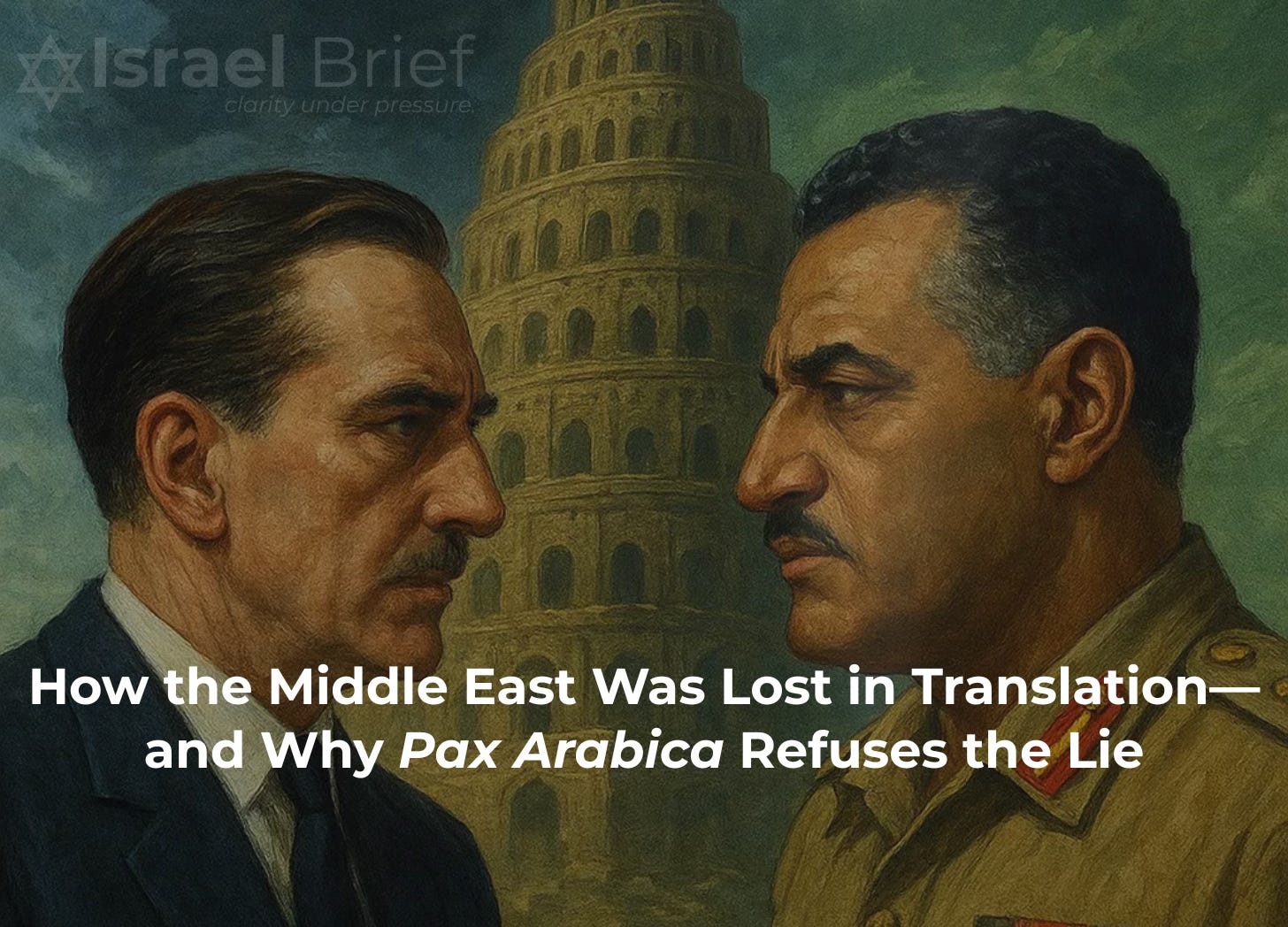
How the Middle East Was Lost in Translation—and Why Pax Arabica Refuses the Lie
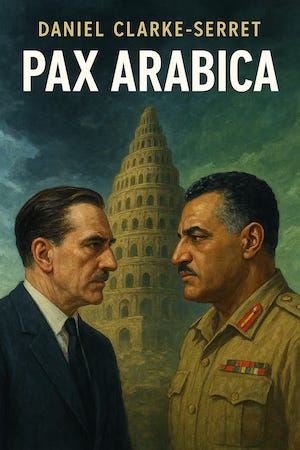
Most books about the Middle East try to sound reasonable. Pax Arabica tries to be accurate.
Thucydides had a line for our moment: “words had to change their ordinary meaning.” When language gets drafted into war, “justice” becomes a cudgel, “genocide” becomes a slogan, and hesitation gets sold as virtue. Clarke-Serret’s book is built as a counterstrike to that corruption. He restores definitions, then he follows the consequences.
Daniel Clarke-Serret’s argument starts where political cowardice refuses to let most people begin. The region’s dominant “anti-colonial” narrative is inverted. The West has spent decades training itself to see only one kind of empire (its own) and only one kind of indigenous legitimacy (the kind that flatters the Western collective guilt). Clarke-Serret opens with Isaiah’s moral inversion—evil relabeled as good. Once you invert the terms, you invert the verdicts
The result is not a “fresh perspective” in the TED-Talk sense. It bluntly names the Arabized-Islamic imperial project—secularized in pan-Arab nationalism, spiritualized in Islamism—and takes it down. Which operates as an empire that expects deference, and punishes dissenters, minorities, and border-breakers with impunity. Israel, in this telling—rather than the region’s colonial irritant—is the region’s most serious obstacle to imperial uniformity. Therefore the permanent target of Islamist efforts.
The framework alone makes the book worth your time. But Clarke-Serret goes further. He builds the case across history, ideology, language, and incentives. And he does so in a way that reads less like an academic treatise (thank HaShem) and comes across more like an engaging seminar that got tired of watching diplomats nod along at lies.
The Architecture: Babel, Then Eden
The structure is effective. Part 1 (“Babel”) diagnoses the system. Imperial continuity. Ideological enforcement. Minority suppression. Along with all the propaganda grammar that lets it masquerade as liberation. Part 2 (“Eden”) pivots to statecraft. What stabilizes regions. What deters violence. What nationhood actually means. Why the West keeps repeating the same mistakes—because, as I often argue, it confuses process for reality.
Calling the first half “Babel” is clever. One language. One identity. One political theology—difference treated as disorder. Clarke-Serret’s claim is that this is not merely a cultural tendency. It shows up in demographics (who disappears), in law (who is permanently second-class), in education (what children are taught), and in foreign policy (which cause(s) must remain sacred to maintain pan-identity discipline).
Clarke-Serret also refuses the comforting mistake of treating this as medieval fanaticism. He argues Pax Arabica was consolidated in the modern world—where democracies, NGOs, and “expert” language can be coaxed into laundering conquest as justice.
“Eden,” meanwhile, is not utopian. It wagers that ordered nation-states are the only sustainable way out of permanent regional war. Clarke-Serret is not naive about what that takes. He sells borders, incentives, deterrence, and the hard moral requirement to name things accurately.
What the Book Gets Right—Repeatedly
It recenters the victims that fashionable politics deletes
If your mental map of the region begins and ends with Gaza headlines, Pax Arabica will feel like an insult—because it refuses to flatter your curated compassion. Clarke-Serret drags the reader through the minoritized, erased, and ethnically cleansed communities that do not trend on Western campuses, Jews across MENA. Kurds. Yazidis. Druze. Christians. Black Africans in Arab-ruled spaces. More. He treats “diversity” as a lived civilizational fact in the Middle East—then shows what happened to it under the dominant imperial identity project.
That move changes the moral arithmetic. When the region is framed as “Israel vs. Palestinians,” the West can keep outsourcing guilt, keep fantasizing about a procedural fix, and keep ignoring the ideological engine. When the region is framed as empire vs. minorities… Israel stops looking like the anomaly. One minority that refused to countenance its own extinction.It treats “language inversion” as a weapon system
Some of Clarke-Serret’s Chapter most useful contributions are grounded in his claim that the modern conflict is fought as much in terminology as in terrain. He’s not talking about euphemisms in the gentle sense. He’s arguing that words like “justice,” “human rights,” “apartheid,” and “genocide” are deployed as instruments—often disconnected from their legal or historical meaning.
Clarke-Serret’s sharper point is older than Twitter and uglier than propaganda. Reason can be weaponized. Thucydides admired evidence and causality, and Athens still descended into sophistry. “Objectivity” becomes camouflage. Numbers become victory. Rhetoric replaces definition. That is how democracies learn to rationalize atrocities while congratulating themselves on procedure.
The West’s moral vocabulary is not simply “misapplied.” It is exploited. Institutions that assume good faith become tools for actors who never intended good faith. Clarke-Serret’s point is that norms without enforcement—and norms selectively enforced—become a trap.
He keeps circling back to the ancient pattern. Civil conflict at Corcyra where courage and recklessness trade names. The strong do what they can. The weak suffer what they must. It’s the engine of the region’s empire project—and the West’s excuse-making habit when minorities get crushed.
It refuses to pretend Islamism is “misunderstood grievance”
The book draws a hard line between private faith and political ideology. Refreshingly, it does not play the modern Western game of pretending political Islam is a misunderstanding. He treats Islamism as a coherent political project with a theory of sovereignty, a theory of conquest, and a theory of hierarchy. You don’t have to adopt every one of Clarke-Serret’s theological or historical emphases to appreciate the underlying realism: movements tell you who they are. Believe them.
Clarke-Serret’s twist is that the region’s rot is not simply religious irrationalism. He describes something worse. Conquest framed as liberatio. And a totalitarian collective identity that speaks as “history” itself—demanding submission while calling it progress.
This is where the book’s tone—unfashionable, impatient, direct—actually becomes a feature. It does not pre-apologize. It does not come across as if the reader’s first obligation is to avoid being disliked.
It models a strategic rather than sentimental pro-Israel case
Plenty of pro-Israel books plead. Clarke-Serret doesn’t. He argues Israel’s legitimacy as (a) indigenous nationhood returning to its origin point, and (b) the functional protector of minorities in a region that routinely punishes minority existence. When he discusses sovereignty, the nation-state, and deterrence, the argument is not “Israel is nice.” It’s “Israel is necessary.”
It understands appeasement as policy habit, not a one-off mistake
Democracies prefer the illusion of stability over the discipline of deterrence. They punish allies who act like adults in a hostile environment. Clarke-Serret treats appeasement as a repeatable Western reflex—a whole chapter’s worth (“On Appeasement”)—and then follows it into the psychology of strength. Predators expand when they smell proceduralism. Committees don’t deter. Borders do. Sheriffs do. Clarity does.
The “Levantia” Chapter: A Thought Experiment With Sharp Edges
A post-Palestinian identity—something like “Levantia”—is intriguing. Though, given the West’s short memory, I worry it could whitewash history. Clarke-Serret’s doesn’t present a naive peace plan, but a recognition that offers a new brand, a new flag, and new civic myths.
His claim is blunt: a “two-state solution” cannot be built on a political identity whose prestige economy is rejectionism and martyrdom. If you keep the identity engine intact, you don’t get a state—you get a launchpad. So he proposes a break: same people, different political story, different symbols, different incentives, and above all, a different educational project.
The break has to be visible where it hurts: schoolbooks, sermons, media, martyr payments, the prestige economy that treats rejection as honor. If the old incentives survive under a new flag, the map changes and the war stays.
This clean break can become a laundering operation if it skips accountability. Renaming something does not redeem it. But Clarke-Serret’s insight still stands. A future requires a civic narrative that does not require Israel’s death to feel meaningful. If that narrative cannot exist, then the conversation is not about borders; it’s about permanent war.
He uses the title with a double edge. Pax Arabica the empire is the regional order built on enforced uniformity and minority submission. Pax Arabica the book is written as an intervention in the modern West’s language crisis—the moment when “justice” became a mask for power and “decolonisation” became a cover story for imperial continuity.
A Necessary Book for an Unserious Era
Pax Arabica is not a book for readers who need their worldview affirmed by institutional approval. It is a book for readers who are tired of watching euphemism replace analysis. It’s for those who understand that moral clarity is necessary—even if the current moment of history treats it as an egregious overstep.
Clarke-Serret’s core contribution is a reframing. Shifting the conversation from a cartoon land dispute to a civilizational and imperial conflict over sovereignty, identity, and the right of minorities to remain alive. He takes the reader through the region’s suppressed record—minorities erased, words inverted, violence excused—and he does it with a thesis strong enough to argue with.
If you want a book that begs the West to be kind, this isn’t it. If you want a book that tells the West to stop being stupid—stop subsidizing narratives that reward rejectionism, stop treating jihadist politics as “context,” stop confusing NGO language with reality—then Pax Arabica delivers.
Clarke-Serret’s bet is simple and unfashionable. Truth exists. Words have meaning. Minorities deserve to live. That includes—especially includes—the indigenous peoples the Arabising whirlwind tried hard to erase. If the West keeps laundering conquest with corrupted terms, it will keep rewarding the strong and sacrificing the weak. Pax Arabica is a refusal to participate in that fraud.
There is a reason Pax Arabica unsettles people before they finish it. It refuses to cooperate with the shortcuts—linguistic, moral, and historical—that now pass for analysis. It insists that empires still exist, that minorities still disappear, and that definition of words still matters even when institutions pretend otherwise.
You do not have to agree with Clarke-Serret at every turn to recognize the seriousness of the project. I’ve definitely argued with some of the pages. It’s a worthy effort to tell the truth in a domain where truth has been aggressively rebranded as cruelty.
