

The Long Brief: Holiday From History [Part 1]
The peace dividend was a vacation. The bill came due.

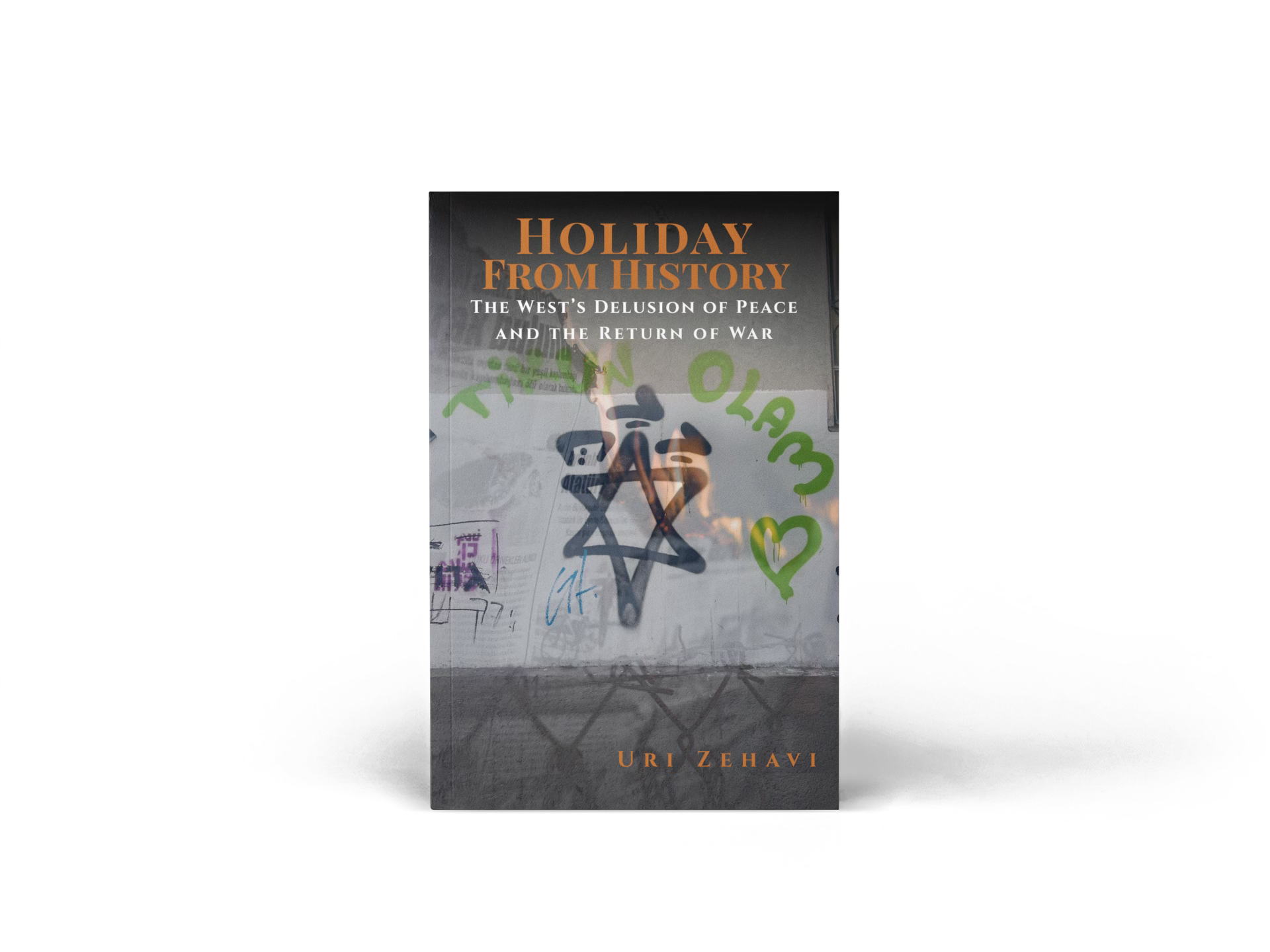
Through February, Israel Brief’s Long Briefs will run a four-part serialization of Holiday From History: The West’s Delusion of Peace and the Return of War. Each week we’ll send out one installment—built to be evergreen, reference-grade. If you’d rather read the full book now you can get a copy of Holiday From History on Amazon.
Shalom, friends.
This first installment lays down the diagnostic. How the West talked itself into believing war was obsolete—and built a culture that treats process as protection.
You’ll see the doctrine (End-of-History thinking), the rituals (paper promises), the structural fog (maps that lie), the ideological blindfold (multicultural complacency), and the elite echo chamber that enforces euphemism as virtue.
Holiday From History:
The West’s Delusion of Peace and the Return of War
Preface: The Idol of Peace
The West treated 1989 as if history itself had surrendered. The Berlin Wall came down, the Soviet empire folded, and pundits announced “the end of history.” Liberal democracy and free markets, they insisted, had triumphed forever.
That confidence hardened into dogma. Peace stopped being understood as a fragile achievement. It was declared the natural state of mankind. Leaders rushed to cash a “peace dividend,” cutting defense budgets and boasting of new spending on welfare schemes. NATO expanded on paper, but its armies withered in practice. Between 1990 and 2000, Europe’s average defense spending dropped from roughly 2.5 percent of GDP to 1.8 percent, and it kept sinking. Germany fell from 2.6 to 1.4. Italy slipped to 1.6. Canada shrank to almost nothing, around one percent. Politicians congratulated themselves while their militaries hollowed out.
Strategy documents of the 1990s read like sermons to this new idol. Great-power conflict was declared “unthinkable.” Treaties multiplied. Conferences bloomed in a “spirit of partnership.” Globalization was the buzzword. Geopolitics was considered passé. Security services relaxed, convinced that fascism and communism had been buried for good.
But peace had not become normal. The West only convinced itself it had. And the West prayed to its idol of peace while much of the world lived inside borders drawn in imperial sand.
Old empires collapsed, and what remained was a wreckage of maps. Diplomats in Washington and Brussels treated those lines as sacred. On the ground, tribes and sects remembered their ancestors long before any “nation-state” was imposed on them.
Look at the Middle East. Sykes–Picot in 1916 carved the Ottoman corpse into Syria, Iraq, and Lebanon. The rulers ignored every ethnic and religious fault line. For a time, colonial officers and later dictators held the lid down. Once the grip loosened, the fractures split wide. Iraq was always an arranged marriage of Sunni, Shia, and Kurds. When the strongmen weakened, civil war erupted. Syria’s “mosaic” of Alawites, Sunnis, Kurds, and Christians did not melt together. It shattered. Empires draw maps. Tribes wait.
The pattern is not confined to Arabs. In 1947, Britain fled India. Partition left rivers of blood, millions displaced, and a permanent duel between India and Pakistan, now nuclear. The border was drawn in haste; the hostility has lasted three generations.
And in the Holy Land: the British Mandate ended with a “partition” that satisfied no one. Israel came into being and fought for survival. Its enemies have never accepted it. The borders changed; the war did not.
The lesson is brutal. Maps can be redrawn in a night. Tribes endure for centuries. Western officials congratulated themselves on diplomacy while ignoring the fires left to smolder. When colonial officers and Soviet commissars withdrew, they left behind frozen wars that thawed quickly. From the Balkans to Judea and Samaria to the Caucasus, the years after 1989 were not an age of peace. They were the return of history through the ruins of empire.
Islam’s Long War
The West’s blindness shows most clearly in how it misunderstands Islamism. For Muslims, history has always been both inward and outward struggle. The Arab conquests of the 7th century built empires that lasted for centuries. The last caliphate, the Ottomans, collapsed only a hundred years ago. The institution died. The dream never did.
Modern Islamism is not a novelty. It is the continuation of a civilizational ambition: restore power, impose sharia, wage jihad against infidels and against Muslims judged insufficiently pure. The Muslim Brotherhood founded in 1928 preached revival through discipline and political power. Khomeini’s revolution in 1979 gave that dream a state, an army, and oil revenues.
Today’s Islamists see the world in binary terms: the ummah—the Muslim community—against the unbelievers. They prosecute this war on five fronts. Terror: violence as spectacle and intimidation. Demographics: migration and fertility as tools of conquest. Lawfare: bending Western courts and the UN to hobble their enemies. Propaganda: networks from Al Jazeera to TikTok pouring poison into public debate. Diplomacy: deals and “dialogues” that mask the same goal of civilizational dominance.
Hamas declares it openly. Hezbollah boasts of it. Tehran funds it. The West, still worshipping peace as normal, refuses to believe them.
Great Powers Did Not Retire
Russia looked finished in the 1990s. Western Europe imagined Moscow might become a partner, even a democracy. Instead, Russia brooded. Putin rebuilt the army and the will to dominate. In 2014, he seized Crimea. The West muttered. By 2022, tanks rolled into Ukraine in the first open conquest of European land since 1945. Cities shelled. Trenches dug. The illusion collapsed. History was back in blood and rubble.
China never stopped playing the long game. While Western pundits praised “peaceful development,” Beijing studied Western wars and prepared its own. It built missiles, fleets, cyber units. It strangled freedom in Hong Kong. It points at Taiwan. It builds islands in the South China Sea and dares neighbors to object. Through Belt and Road it ties Asia, Africa, and Europe into economic chains. Engagement did not liberalize China. It fortified the Party. Beijing never declared the Cold War over because it never believed it was.
South Asia stayed hot. Partition’s wound still bleeds. India and Pakistan tested nuclear weapons in 1998 and turned every skirmish into a nuclear gamble. Kashmir smolders. The 2008 Mumbai massacre proved the fuse is always lit. Western leaders offered “confidence-building measures.” Nothing built confidence. The frozen war remains one misstep from catastrophe.
Then North Korea. The dynasty chose famine over surrender and fed its people to missiles. Western aid talks bought time for nuclear tests. By the 2010s, Pyongyang had nukes and rockets that could hit continents away. A starving cult with ICBMs—yet Western elites still spoke of peace as the human norm.
Russia. China. South Asia. North Korea. Different stories, one pattern. When the West stopped guarding, others seized the field. Old empires and new tyrants didn’t retire. They regrouped, rearmed, and stepped back onto the stage.
If the West wants to endure, it must relearn something old: goodness requires defense. Jewish life expresses this through two paired ideas. Tikkun olam means repairing the world. Shmirah means guardianship. The one without the other is hollow.
For decades, Western elites clung to a secular tikkun olam stripped of shmirah. They preached about abolishing war, dismantling borders, banning nuclear weapons. Noble slogans, useless without defense. Jews never had the luxury of such illusions. We pray for peace but hire guards at the synagogue door. After the Holocaust, Israel absorbed millions of refugees and built a flourishing society, but it also built an army.
Christian traditions once spoke with clarity about just war and spiritual struggle. Many of their institutions now confuse “love your enemy” with “pretend you have none.” This rot produces compassion without protection. Wolves are indulged as lambs. An ethical spine holds both compassion and strength. Feed the poor, but lock your doors. Forgetting Auschwitz, forgetting 9/11, forgetting October 7 invites repetition. Evil waits for amnesia (and flourishes, relishes in it).
After the Cold War, the West convinced itself that peace was permanent and required no effort. That fantasy disarmed minds and militaries. It left us blind to the rise of Islamism, to Moscow’s revanchism, to Beijing’s ambitions.
The chapters ahead move from diagnosis to action. First, how the peace delusion took hold in the 1990s. Then, the forces that advanced while we slept: jihadists, authoritarian regimes, the collapse of empires and the return of tribes. Next, how our own institutions—media, universities, governments—helped these enemies by denying they exist. From there, case studies of war’s return: rockets out of Gaza, trenches in Donbas, threats in the Taiwan Strait. And finally, a path forward: how to rebuild the ethic of shmirah, strengthen our defenses, and form alliances rooted in clarity instead of wishful thinking.
This is not a chronicle of terror. It is not a lament. It is a rallying cry. Russia’s invasion of Ukraine in 2022 and Hamas’s pogrom in 2023 were not “incidents.” They were thunderclaps warning us that history has returned. My promise is blunt: no euphemisms, no hedging. We have enough of that already. What follows is evidence, argument, and solutions, guided by the belief that free societies are worth defending.
We are at a civilizational crossroads. Either we shatter the idol of false peace or history will shatter us. The time for illusions is over. The time for guardianship has come.
Introduction: October 7, 2023
At dawn the sky over southern Israel was clear and still. It was Simchat Torah, the last day of the harvest festival. On the kibbutzim near Gaza, families lingered in holiday calm. In the desert fields by Re’im, thousands of young people were wrapping up a night of music at the Nova festival. Then the sirens wailed.
At 6:30 a.m. Hamas launched thousands of rockets at towns from Ashkelon to Sderot. For locals, rockets meant a sprint to shelters—ugly, but routine. This time, the rockets were cover. Minutes later came the sound Israelis never expected to hear inside their own communities: automatic gunfire.
Dozens of Hamas squads breached the border in trucks, motorcycles, even paragliders. They blew holes in the fence with explosives and bulldozers, then poured through. At Be’eri and other kibbutzim, men in fatigues kicked in doors, firing grenades and rifles into homes. People drinking morning coffee were executed in kitchens. Holocaust survivors were murdered in their beds. Parents tried to hide children in closets and baskets. Some were saved. Many were not. Houses were torched with families trapped inside. Terrorists shot pets, cars, even water tanks to leave only wreckage.
At Nova, paragliders landed near the stage and gunmen opened fire on the crowd. Panic swept through the fields. Hundreds ran; many fell. The attackers hunted among the cars and tents, dragging women away, finishing off the wounded, laughing as they did it. By the time the killing stopped, 260 festival-goers were dead.
That morning stripped away every illusion of safety. Israel had not faced a pogrom of this scale since 1948. The West could pretend history was over. Hamas proved it was not.
The Hamas assault was no riot. It was a planned military operation aimed at civilians. Hamas called it Operation al-Aqsa Flood. Iran bankrolled and trained it. Israel’s complacency made it possible.
It began with rockets—over 3,000 in an hour—meant less to kill than to saturate Iron Dome and drive Israelis into shelters. While people ducked for cover, Hamas moved to its real objectives at the border.
Small drones dropped explosives on Israeli cameras and gun positions. Surveillance towers went dark. Communications were jammed. For the first crucial hour, many communities could not even call for help.
Then came the breaches. Teams blew holes in the fence with explosives. Bulldozers shoved gaps wider. Convoys of trucks and motorcycles poured through. In one grotesque trick, attackers used a truck painted like an IDF vehicle to ambush a border outpost. They carried maps of kibbutzim, down to the location of nurseries and dining halls. The precision showed months of rehearsal.
Within minutes, Hamas gunmen were inside homes. Some used megaphones in Hebrew, pretending to be Israeli soldiers. Families who trusted the lie stepped out and were slaughtered. Others were burned alive in houses set on fire. The cruelty was not incidental. It was the point.
Iran’s hand was visible. The rockets and drones were Iranian-made. Hamas commanders had met Iranian and Hezbollah officials in Beirut weeks before the attack. Tehran wanted Israel distracted, and its proxies delivered.
Hamas also came ready to take hostages. Fighters carried zip ties, handcuffs, even food for captives. By late morning, more than 200 Israelis—babies, teenagers, the elderly—had been dragged into Gaza. Some were paraded through the streets to cheering crowds before being hidden in tunnels. Hostage-taking was not improvisation. It was part of the battle plan.
By the time the army regained control nearly two days later, over 1,200 Israelis were dead. Entire kibbutzim were wiped out. Soldiers fell fighting to retake villages. Hamas celebrated what it called a victory. In truth, it was a massacre carefully engineered in advance, designed not only to kill but to tear at the very sense of safety in the Jewish state.
October 7 ended the fantasy that Hamas could be managed. For years, officials in Israel and the West spoke of “rounds” of conflict as if they were weather patterns—ugly but predictable. Hamas was said to be pragmatic, tied down by salaries and sewage pipes, unwilling to risk its little kingdom in Gaza. Deterrence was supposed to hold. It didn’t. Hamas proved it was willing to bring ruin on Gaza and itself if it meant murdering Jews. Containment collapsed with the fence.
The attack exposed Hamas’s real creed. Many outsiders dismissed its calls to destroy Israel as bluster. They imagined Hamas as a nationalist militia, a political actor angling for leverage. October 7 tore that mask off. The butchery—the rapes, mutilations, toddlers shot, grandmothers executed—wasn’t military action. It was a pogrom with modern weapons. This was genocide in intent and practice, kin to ISIS and to the worst chapters of Jewish history. Israelis saw with searing clarity: this is not a rival to negotiate with. This is an enemy that wants you gone because you are a Jew.
It also revealed a failure inside Israel. A country famed for the best intelligence in the region, a nation that prides itself on constant readiness, was blindsided. Warnings were missed. Unusual movements were brushed aside. The assumption—that Hamas was deterred, more interested in permits and cash than in slaughter—had sunk deep into the security system. On that morning, the guardians of Israel were looking the wrong way, lulled into the same delusion of peace they used to mock abroad. The reckoning that followed cut to the bone.
Outside Israel, the attack broke another illusion: the lazy language of a “cycle of violence.” For years pundits used that phrase to suggest symmetry, as if Hamas rockets and Israeli responses balanced out in a grim rhythm. October 7 obliterated that narrative. It was not a cycle. It was a massacre. The scale, the cruelty, the intent demanded moral clarity. Yet much of the world flinched. Some tried to fit the carnage back into their old templates. Others excused it outright. Their reaction proved almost as revealing as the attack itself.
The days after October 7 should have brought moral clarity. Some governments lit landmarks in blue and white. Citizens sent messages of support. But another current surfaced fast: rallies that excused or celebrated slaughter. The West looked in the mirror and saw fracture lines.
In Sydney, the Opera House glowed with Israel’s flag. On its steps, crowds waved “Palestinian” banners, lit flares, and shouted chants that reeked of pogrom. The image was jarring: one of the world’s great symbols of culture split between solidarity and hate.
London erupted within 48 hours. Marchers paraded with Hamas insignia and chanted “From the river to the sea”—a slogan that erases Israel. Some praised the massacre outright. British Jews, stunned by events in Israel, now felt unsafe in their own capital.
Across the Atlantic, the rot was academic. At Harvard, more than 30 student groups signed a letter blaming Israel entirely. No mention of murdered babies or raped women—just a neat inversion that could have been drafted in Hamas’s press office. Employers withdrew offers. Alumni recoiled. The administration muttered a late, tepid disavowal. At Cornell, a professor called the massacre “exhilarating.” That word alone told us what ideology had done to the academy.
Media wavered too. Headlines spoke of “clashes,” as if Hamas and toddlers were equal combatants. The BBC refused to call Hamas terrorists, clinging to its style guide while Israelis buried children. At the UN, even a resolution condemning Hamas met resistance. Delegates wanted “context,” as if context could sanitize butchery.
For Hamas, this was victory. The killers knew Western elites had marinated students and activists in a story of oppressors and oppressed. They knew enough would cheer or equivocate. On October 7, they tested the West’s moral spine. Too many bent. Some snapped.
Peace is a pause; never a promise. October 7 proved it. In a few hours, the fantasy that the West had outgrown barbarism collapsed in smoke and blood.
Hamas’s massacre was a shatter point. It exposed the same delusion that left Israeli kibbutzim undefended, Europe dependent on Moscow, and the free world scrambling to contain Beijing. The belief that history’s wars were over led to mental and moral disarmament. Those who never stopped believing in war—jihadists, autocrats, fanatics—took their chance.
Hamas is not an exception. It is the latest expression of a long war. Russia’s conquest of Ukraine and China’s threats to Taiwan are not relics. They are reminders. “Never again” is not a guarantee. On October 7, genocide tried to return. The peace after the Cold War was only an interlude, maintained by the strength of the past. Once the West convinced itself history was tame, history struck back.
This book argues for shmirah—guardianship—as the condition of peace. Without vigilance, peace rots. Tikkun olam, repairing the world, is empty without defense. Peace must be built, guarded, and guarded again. Israel paid the price of neglect on October 7. The West will pay a far higher price if it fails to learn the lesson.
What follows is not a call to despair or to militarism. It is a call to sober realism. War and rivalry remain history’s constants. Pretending otherwise is suicide. The holiday is over. The test is how we face history’s return.
This book deals in clarity. Euphemism and hedging have crippled the West’s ability to see danger; they won’t appear here. When Hamas carried out a massacre, that is what it was—not “militants” clashing, not “unrest.” Terrorists murdered Jews. We will call it by its name. The same bluntness applies to our own societies. Western leaders who stumbled, even with good intentions, will be judged plainly. Papering over failure guarantees we repeat it.
The method is simple: history, politics, ethics, examined together. We move from ancient empires to modern battlefields, from policy data to Jewish ideas. Concepts like shmirah—guardianship—and tikkun olam—repair—give us words English often lacks. They are not sermonizing. They are lessons forged in Jewish experience that the West urgently needs.
Every claim here is grounded in evidence. No conspiracy theories. No lazy generalities. The tone is blunt because equivocation has already cost us too much. Clear words are the first step toward clear choices. The story ahead is grim at times, but not hopeless. Realism is not despair. It is the precondition of renewal. What follows is written with open eyes and moral confidence. The holiday from history is over. The only way forward is to face what returned.
Part One: The Myth of Order
Chapter 1: Fukuyama’s Folly
In 1989 the Berlin Wall fell, the Soviet empire cracked, and the West told itself a story. Liberal democracy had triumphed. Communism was finished. Peace was at hand.
Francis Fukuyama gave the mood its slogan: “the end of history.” Not the end of events, but the end of mankind’s great ideological struggles. Liberal democracy and free markets had won. Everyone else, sooner or later, would converge. There might be quarrels, but no more civilizational clashes.
Elites embraced this as gospel. The Cold War was over, therefore war itself was over. They acted as if the hard work of defense, vigilance, and memory could be abandoned. It was seductive. It was also a delusion. History had not ended. It had only paused, waiting for the West to look away.
Fukuyama’s thesis, first an essay in 1989 and then a 1992 book, argued that liberal democracy was the final stage of political development. Future wars, he suggested, would be peripheral, manageable. That claim leapt from seminar rooms to statecraft. In the 1990s, “End of History” became shorthand for the new normal. Leaders cashed in a “peace dividend.” Defense budgets shrank.
The cuts were real. Germany went from 2.6 percent of GDP on defense in 1990 to about 1.2 percent a decade later. Canada slid to barely 1 percent. Britain slashed its army by a quarter and retired ships early. A reunified Germany cut its forces from roughly 600,000 to under 350,000. The United States joined in. Active-duty troops fell by a third, from 2.1 million to 1.4 million. Army divisions dropped from 18 to 10. Spending sank to 3 percent of GDP by 2000. Republicans and Democrats alike called this responsibility. In truth, it was a holiday.
The spirit went beyond budgets. Globalization was hailed as the new security architecture. Pundits mocked old geopolitics and cheered a “flat world” where markets trumped armies. NATO expanded, the EU deepened, and Russia was labeled a “strategic partner.” China entered the global trade system. Davos panels and State Department briefings sounded the same: history’s conflicts were over, institutions and commerce had secured peace. Even pop culture joined in with the “Golden Arches Theory”—no two countries with McDonald’s would fight each other.
Reality disagreed. In 1993 a truck bomb tore through the World Trade Center. In 1994 Rwanda’s genocide killed 800,000 in three months. In 1998 al-Qaeda bombed U.S. embassies in Kenya and Tanzania, killing more than 200. In 2000 a suicide boat nearly sank the USS Cole, killing 17 sailors. Each outrage was treated as an aberration, a crime, a tragedy—not a warning that history was stirring. Policymakers still insisted the default setting was peace.
Into this atmosphere walked a heretic. If Fukuyama’s “End of History” was gospel, he argued the opposite. History was not over. It was gathering. His name was Samuel P. Huntington.
In 1993, Harvard’s Samuel Huntington published “The Clash of Civilizations?” He dropped the question mark in his 1996 book. His claim was blunt: the great divides of the post–Cold War world would not be ideological or economic. They would be cultural. Religion, history, and language would mark the front lines. Nation-states would still matter, but the bitterest wars would erupt along civilizational fault lines—Western, Orthodox, Islamic, Sinic, Hindu, and others. History wasn’t over. It was alive and dangerous.
Western elites hated the message. Critics accused Huntington of essentialism, of stoking self-fulfilling wars. His focus on Islam’s “bloody borders” was denounced as crude and bigoted. In the triumphant 1990s, globalization and interdependence were the preferred gospel. Huntington’s thesis was dismissed as a relic, too grim for the liberal age.
And yet the decade unfolded exactly along his map. The Balkans split into Orthodox Serbs, Catholic Croats, and Bosnian Muslims, with atrocities fueled by old resentments. In Chechnya, Russia fought two savage wars against Muslim separatists, and foreign jihadists poured in to help. In Nagorno-Karabakh, Christian Armenians and Muslim Azeris clashed again. Each conflict bore the mark of civilizational fault lines.
Israel stood at the crossroads. The Oslo euphoria of 1993 collapsed into the Second Intifada by 2000, marked by suicide bombings and Islamist rhetoric. What had once been framed as nationalist struggle revealed itself as civilizational confrontation. Hamas and other jihadists tied the “Palestinian” cause into a global Islamic war narrative. Al-Qaeda recruited fighters by invoking Bosnia, Chechnya, and Palestine in one breath. Huntington’s schema fit like a glove.
Then came September 11. Nineteen jihadists struck New York and Washington, targeting the symbols of Western finance and power. It was the clearest proof yet that parts of the Islamic world did not accept the West’s claim to universality. Western leaders still refused to call it a civilizational clash—President Bush took pains to say America was not at war with Islam—but the reality was obvious.
The 2000s should have silenced Huntington’s critics. Instead, many doubled down on the End of History faith. Afghanistan and Iraq were recast as laboratories to prove liberal democracy inevitable. Nation-building would cure jihad. History, they insisted, still bent toward peace. Huntington had already warned otherwise.
Islamism Fills the Vacuum
When communism fell, many in the West assumed no rival ideology remained. One did. Islamism—political Islam as a program for rule—stepped forward. Not Islam the faith. An ideological project to impose strict sharia through revolution, terror, and state power.
Its roots were ready. The Muslim Brotherhood (founded 1928) preached revival by discipline and politics. Sayyid Qutb supplied the doctrine of purification by jihad. In 1979 Khomeini proved a theocracy could seize a modern state and keep it. By the late 1980s the Sunni stream matured too. In 1988, veterans of the Afghan war around Osama bin Laden founded al-Qaeda to carry the fight beyond Afghanistan and toward a restored caliphate.
The 1990s brought warning shots. In 1993 a truck bomb hit the World Trade Center. In 1996 a truck bomb killed 19 U.S. airmen at Khobar Towers. In 1998 twin truck bombs destroyed the U.S. embassies in Nairobi and Dar es Salaam, killing 224. In 2000 a suicide craft tore open the USS Cole in Yemen, killing 17 sailors. Each time, the response treated jihad as crime, not war. Files were opened. Indictments were drafted. Networks kept breathing.
Then 9/11. Nineteen al-Qaeda operatives turned airliners into missiles and struck New York and Washington. The United States toppled the Taliban that sheltered al-Qaeda and reorganized for a long fight. Yet even then, many in Washington tried to redeem the End of History by nation-building. Democratize Kabul and Baghdad and the fever would break. It didn’t.
Iran advanced while we argued. The Islamic Republic and its IRGC-Quds Force built a state-backed jihad network from Beirut to Sana’a. Hezbollah matured into a hybrid army and political machine, financed and trained by Tehran and routed through Damascus. In 1994 its operatives bombed the AMIA Jewish center in Buenos Aires. By the 2000s Hezbollah held the south of Lebanon and stockpiled rockets by the tens of thousands. Tehran also funded Sunni proxies when useful. Hamas and Palestinian Islamic Jihad drew money, weapons, and training despite the sectarian divide. The common goal—erase Israel—made the partnership easy.
Western policy in the 1990s and early 2000s misread the picture. Leaders clung to a “law-enforcement paradigm,” as if terror were a tactic without an ideology. Agencies stovepiped intelligence. Known extremists learned to fly; no one fused the dots. We spoke about “terror” in the abstract and avoided the word Islamism in public. The enemy did not return the favor. Bin Laden issued fatwas declaring war. Tehran chanted “Death to Israel. Death to America.” They meant it.
The idea kept spreading. In 2014 ISIS overran large parts of Syria and Iraq and declared a caliphate the size of Britain. Thousands of recruits streamed in from Europe, North Africa, and beyond. Affiliates sprouted from the Sahel to the Philippines under the ISIS banner. Meanwhile Iran armed its proxies with rockets and drones and poured money into the Assad war and the Houthis. Estimates placed annual support at roughly $700 million for Hezbollah and at least $100 million for Hamas and Islamic Jihad, on top of broader regional spending. That is not a hobby. It is a strategy.
Islamism filled the ideological vacuum because the West left it open. While we congratulated ourselves on a world without grand struggles, our enemies built one.
In July 2006 Hezbollah ambushed an Israeli patrol, killing and kidnapping soldiers. Israel struck back. Hezbollah answered with a month of rocket fire and dug-in combat that stunned the world. Over 34 days, the group launched about 4,000 rockets into northern Israel. A million Israelis spent weeks in shelters. Cities shut down.
Hezbollah was no ragtag militia. Its fighters were drilled, bunkered, and armed with advanced Iranian and Syrian weapons. They fired anti-ship missiles that hit an Israeli naval vessel and used Kornet anti-tank missiles to disable Merkava tanks. Of the 120 Israeli soldiers killed, many fell in direct clashes against entrenched units in south Lebanon. Israel bloodied Hezbollah, but it did not destroy it. Among supporters, the group claimed a “divine victory.”
The war revealed something new. A state-backed militia could fight a modern army to a standstill. Hezbollah began with an arsenal of around 15,000 rockets—more than many national militaries—and sustained daily barrages of 100 or more. Its tunnel and bunker networks blunted Israel’s airpower. It blended terrorism, guerrilla tactics, and conventional arms into a hybrid force that neutralized much of Israel’s technological edge. For Western observers, this was the future: non-state actors wielding the firepower of small states. Hezbollah only grew stronger after 2006. Today its arsenal is estimated at over 130,000 rockets, including precision-guided missiles.
For Israel the lesson was bitter. Complacency and faith in technology left it unprepared for the scale of Hezbollah’s buildup. For the West, the parallel was obvious. While democracies congratulated themselves on the end of history, their enemies stockpiled strength. Hezbollah 2006 was a preview of the world we now live in—where ideology, state sponsors, and patient preparation can shatter illusions of peace in a single campaign.
The peace dividend was real. Budgets shrank, armies withered, and capabilities rotted away. Germany cut defense to around 1.2 percent of GDP and let its force structure collapse. By the 2020s, the Bundeswehr could field maybe 200 tanks, down from 7,000 at the Cold War’s end. A German audit found ammunition on hand for two days of high-intensity combat. Britain slashed its army and discovered it had only weeks of missile stocks. In NATO exercises, German crews once strapped painted broomsticks to vehicles to simulate machine guns. It became a symbol of the age—an alliance that congratulated itself on “progress” while hollowing out its ability to fight.
The United States also drew down. From the late ’80s to the late ’90s, active forces fell by a third, Army divisions from 18 to 10. Spending dropped to three percent of GDP. Even after the War on Terror build-up, Washington cut back again in the 2010s. The assumption—shared across parties—was that no great-power war loomed. History was supposedly finished.
This complacency extended to diplomacy. Treaties and frameworks multiplied: Oslo, the Agreed Framework with North Korea, the Budapest Memorandum, endless Balkan accords. Process became fetish. Paper was treated as power. Adversaries treated those papers as invitations. Russia pocketed Ukraine’s denuclearization guarantees in 1994, then annexed Crimea in 2014. North Korea signed pledges while racing for the bomb. Hamas signed Oslo, then launched the Second Intifada. Western capitals preferred signatures to vigilance.
Warnings were brushed off. The 1993 World Trade Center bombing, the USS Cole, embassy bombings in Africa—handled as crimes, not acts of war. Russia’s cyberattack on Estonia in 2007, its invasion of Georgia in 2008—met with token sanctions and quick resets. China’s island-building and military surge were waved away with the mantra that commerce would civilize Beijing.
Behind this was moral vanity. Elites believed history bent inevitably toward peace. Anyone warning otherwise was mocked as paranoid, warmongering, or Islamophobic. Vigilance was treated as a vice. In Jewish terms, tikkun olam—repairing the world—was pursued without shmirah, without guardianship. It was noble, and naïve.
The result was a West unready in mind, military, and spirit. It cut weapons, ignored threats, and shamed those who urged vigilance. Adversaries noticed. They never thought history had ended. They prepared while we vacationed.
A civilization that declares history over is one that invites its return—with force.
Chapter 2: Paper Promises
In the 1990s the West took a holiday from history. The Cold War’s end convinced leaders that liberal democracy had won forever, that peace was now the default setting of mankind. Confident in this illusion, they turned diplomacy into ritual.
Wars were treated as paperwork problems. Hold a summit, draft an accord, stage a photo-op—then declare peace achieved. Treaties became talismans. Ink on paper was supposed to erase centuries of strife.
It never worked that way. From Oslo to the Iran nuclear deal, Western leaders celebrated the signing ceremony while violence raged on the ground. Agreements became shields for aggressors, not restraints. Paper without power doesn’t end war. It invites it.
On September 13, 1993, Yitzhak Rabin and Yasser Arafat shook hands on the White House lawn. Cameras framed it as history. Israel recognized the PLO. The PLO said it recognized Israel and renounced terror. A Nobel followed. On paper, peace had begun.
In reality, Oslo built a process and a bureaucracy, not peace. Israel handed governance in Gaza and in major towns of Judea and Samaria to Arafat’s new Palestinian Authority, allowed exiled leaders to return, and armed PA police. Donors poured in billions to build institutions. The “peace industry” bloomed. Violence did too.
Arafat spoke in two languages. In English, “peace of the brave.” In Arabic, a different message. In May 1994, at a Johannesburg mosque, he likened Oslo to Hudaybiyyah—a tactical truce to be broken when strong enough. The point was plain. Use the accord to gain time, funds, and leverage. Keep the war alive.
Incitement never stopped. PA media glorified “martyrs.” Textbooks erased Israel. Maps lied. Sermons dehumanized Jews. Streets and camps were named for bombers. The PLO charter’s promise to end the armed struggle never truly materialized. Senior figures signaled the conflict was not over. “We reserve the right to return to resistance,” Mahmoud Abbas said years later.
The “revolving door” policy did the rest. Under pressure, PA police detained Hamas and Islamic Jihad operatives, then released them or gave them soft custody. Bomb workshops operated under PA noses. Off-duty Fatah men moonlighted as gunmen. Terror climbed. In the six years after Oslo’s signing, roughly 300 Israelis were murdered in attacks. Buses and cafés in Tel Aviv and Jerusalem exploded. Then came 2000. Camp David collapsed after Ehud Barak offered a state in Gaza and most of Judea and Samaria, a capital in parts of East Jerusalem, and creative arrangements for holy sites. Arafat said no and offered nothing. The Second Intifada followed—organized shootings and suicide bombings, many run by Fatah-linked cells. In 2001 more than 200 Israelis were killed. In 2002 about 450. Most were civilians: buses, restaurants, a children’s pizzeria.
International indulgence masked accountability. Arafat toured world capitals, praised as a partner, while donors kept the PA solvent—even as salaries reached Al-Aqsa Martyrs’ Brigades. The UN stacked resolutions against Israel, year after year, while “Pro-Palestinian” terror drew no special sessions. Israel’s self-defense was litigated; the murder of Israelis was rationalized as a “cycle of violence.”
Israel ended the slaughter by force, not by paper. It built a barrier to stop bombers, dismantled terror infrastructure in Operation Defensive Shield, and targeted commanders. Arafat died in 2004, confined to Ramallah. The bombs dwindled because deterrence returned, not because the process worked.
Oslo’s lesson is hard and simple. Paper that is not backed by changed intent and hard power rewards aggression. It created ministries and photo ops. It normalized the PLO without transforming it. It gave Arafat medals and money. It did not end the dream of “from the river to the sea.”
The same faith in documents would surface again—in a nuclear deal that promised stability while the threat matured. After Oslo’s mirage came the paper shields.
In July 2015 diplomats signed the Joint Comprehensive Plan of Action in Vienna and declared the Iran problem solved. President Obama called it hope over fear. Many in the West exhaled, as if a war had been averted. The relief was political. The danger remained.
The JCPOA narrowed one file and ignored the rest. It capped uranium stockpiles at about 300 kilograms, held enrichment to 3.67 percent, limited older centrifuges at Natanz, paused Fordow, and rearranged Arak. Inspectors got more access to declared sites. Breakout time stretched to roughly a year—on paper.
The deal left Iran’s missiles and its regional war machine untouched. The UN’s language on missiles “called upon” Tehran to show restraint. Tehran ignored it. The IRGC and Quds Force kept arming Hezbollah, Hamas, and the Houthis, and kept building militias in Iraq and Syria. Nuclear physics sat in one box. Everything else raged outside it.
Sunset clauses made the box temporary. Arms embargoes expired in 2020. Missile restrictions lapsed in 2023. Advanced centrifuge work expanded after year eight. Quantitative limits phased out after year ten. By year fifteen, core constraints vanished. Iran unplugged machines and stored them, waiting for the clock. Knowledge stayed. Infrastructure stayed. The pause favored the patient.
Cash arrived fast. Sanctions relief unlocked tens of billions. Oil exports surged. Military spending jumped. The IRGC got paid. Within weeks Qassem Soleimani flew to Moscow in defiance of a UN ban and coordinated the Syria campaign. Iran and Russia rescued Assad, built permanent positions in Syria, and pointed them at Israel. Hezbollah’s arsenal swelled into six figures, with precision projects underway. In Iraq, Iran-backed militias fought ISIS, then entrenched as a parallel state. In Yemen, Iranian-designed missiles and drones hit Riyadh and Abu Dhabi. The region absorbed the cost of our “success.”
Supporters said the deal bought time. It did. Iran used the time to get stronger. In 2018 Israel exposed a secret nuclear archive that proved Tehran had lied about never pursuing weapons work and had saved the plans. Inspections never offered no-notice access to military sites. Procurement networks kept hunting dual-use gear. Compliance was technical. Strategy was hostile.
When Washington left the deal in 2018, Tehran showed how quickly it could shed restraints. It spun advanced centrifuges, blew past stockpile limits, and enriched up to 60 percent. Breakout shrank. Regionally, nothing moderated. U.S. positions in Iraq took rocket fire. Iranian drones struck Saudi oil facilities. Israel hit IRGC sites in Syria while Hezbollah sat on a precision-guided powder keg.
The JCPOA repeated Oslo’s mistake at scale: celebrate signatures while adversaries bank leverage. Paper provided cover. Aggression advanced. The nuclear file became a trophy of multilateralism that insulated Tehran from pressure on missiles, terror finance, and proxy wars. Western officials warned allies not to “spoil the deal.” Iran spoiled the region.
If Oslo was a mirage that a handshake could end a century-old war, the JCPOA was a mask that a 150-page document could civilize a revolutionary regime. Both rewarded process over power. Both told enemies that patience beats promises. The next question is obvious: why do our institutions keep doubling down on process even when outcomes collapse?
How did we end up worshiping process? A class of officials and experts decided that meetings equal progress. If people kept talking, something good must be happening. Failure meant schedule another round. The goal became the communiqué, the framework, the photo at the podium. Reality on the ground was treated as a rude interruption.
Bureaucracy helped. A peace industry grew up around the table: envoys, NGOs, think tanks, conference circuits. Careers and budgets depended on keeping talks alive. Inputs replaced outcomes. Hours logged beat results achieved. In this world, engaging an adversary is virtue enough, even when the adversary uses the pause to reload.
Listen to the language and you hear the creed. Summits “reaffirm,” “urge,” and “commit to further dialogue.” Verbs that bite—disarm, dismantle, defeat—vanish. “Confidence-building measures” multiply while confidence in reality evaporates. The prose gets elegant as the content gets empty. It reads like poetry for people who fear nouns.
Authoritarians learned the script. Show up. Smile. Stall. Pocket concessions. If a democracy balks, accuse it of “sabotaging peace.” Western diplomats, terrified of being the spoiler, pressure allies to “be flexible.” The result is a process that rewards delay and punishes candor.
The record is brutal. UN Security Council 1701 ended the 2006 Israel–Hezbollah war on paper. It promised a Hezbollah-free zone south of the Litani and UN enforcement. Hezbollah rearmed to the teeth. UNIFIL watched. Tunnels crept toward Israel. The paper tied Israel’s hands while Iran’s proxy sharpened its knives.
The Budapest Memorandum persuaded Ukraine to surrender the world’s third-largest nuclear arsenal for “assurances.” In 2014 Russia took Crimea. In 2022 it invaded outright. The memorandum did not keep the peace. It advertised the prey.
Minsk I and II froze Russia’s first incursion in Donbas. They also locked in Moscow’s gains, forced Kyiv into talks with its own occupiers, and bought the Kremlin seven years to rebuild for a larger war. Europe mistook a slow burn for a stable ceasefire. Then the house went up.
There is a counterexample, and it proves the rule. Dayton worked in Bosnia because NATO first imposed facts with airpower, then enforced the agreement with 60,000 troops. Paper memorialized power. It did not pretend to replace it.
The point is not to sneer at diplomacy. It is to restore sequence and spine. Talk after you have leverage. Sign when you can enforce. Do not confuse a press conference with a settlement. In Jewish terms, shalom is a value, but shmirah—guardianship—keeps it alive. Without guardianship, process is paint over termites.
Paper without power invites predators. We saw it with Arafat’s “process,” with Iran’s nuclear “compliance,” with Hezbollah’s “ceasefire,” with Putin’s “mediation.” The predators understood the cult better than its priests.
Enough liturgy. If you want peace, bring strength to the table and a clock the enemy does not control. Otherwise, you are not negotiating. You are feeding the meter.
Chapter 3: Maps and Masks
In 1915 a British official traced a neat line across a wartime map and proposed a border “from the ‘E’ in Acre to the last ‘K’ in Kirkuk.” A finger flick. A future. Imperial cartography worked like that: rulers and pens in London and Paris, peoples and consequences somewhere else.
Europe had long confused states with nations. A state is a government with borders. A nation is a people with shared identity. In Europe the two brawled their way into rough alignment. In the Ottoman East, officials tried to conjure nations by decree. They assumed identities would kindly grow to fit the lines.
They did not.
In 1916 Britain and France signed Sykes–Picot, a secret plan to divide the Arab provinces of the Ottoman Empire. Oil, canals, rails, prestige—those were the motives. The lines cut across tribes and sects with cheerful indifference. After 1918, San Remo and Cairo turned the sketch into mandates. Britain took Iraq, Transjordan, and Palestine. France took Syria and Lebanon. These were administrative inventions wearing national costumes.
Iraq. Ottoman Iraq had been three provinces: Mosul, Baghdad, Basra. London fused them into one kingdom to secure Mesopotamian oil and a land bridge to the Mediterranean. The result bundled Sunni Arabs, Shi‘a Arabs, and Kurds under one flag. A Sunni monarchy sat atop a Shi‘a majority and a large Kurdish minority. The state functioned when force was abundant and identity suppressed. When Saddam fell in 2003, the mask slipped. Civil war followed. The Kurds moved toward de facto independence. ISIS thrived where the map had never matched the people.
Syria. France split the mandate into sectarian and regional mini-states—Damascus, Aleppo, an Alawite enclave, Jabal Druze—then stitched them back together. The military became a ladder for rural minorities. In 1970 Hafez al-Assad, an Alawite, seized power. The regime spoke Arab nationalism but ruled through sectarian networks and security organs. In 2011, when authority cracked, the country fractured along the lines the French once drew. The Kurds carved an autonomous zone. Iran and Hezbollah armed the regime. The map held only where force returned.
Lebanon. Paris carved Lebanon from coastal Syria in 1920 as a Maronite-led state and added Muslim hinterlands to make it viable. Independence in 1943 froze sectarian balance in law: Maronite president, Sunni prime minister, Shi‘a speaker. Demography shifted. Refugees arrived. The fiction collapsed into civil war in 1975. Syria occupied. Iran’s proxy Hezbollah entrenched as a state within the state. Today a militia outweighs the national army. The confessional pact survives on paper. Power lives elsewhere.
The pattern is consistent. The farther a colonial border strayed from lived identities, the more violence was required to keep it in place. Maps are masks. They cover tribe and sect only while bayonets hold. Remove the force and the old faces return.
Partition of India: Drawing Blood into a Border
In 1947 Britain rushed out of its empire’s crown jewel and left behind two states—and a human catastrophe. India and Pakistan were born not from careful planning but from a hasty compromise. A single British lawyer, Cyril Radcliffe, who had never set foot in India, was given a few weeks to carve Muslim-majority Pakistan from provinces where Hindus, Muslims, and Sikhs had lived side by side for centuries. The line he drew, the Radcliffe Line, was law by August 15. It was faster than a census. The dead supplied the rest of the data.
Violence followed immediately. Punjab and Bengal erupted. Trains pulled into stations packed with corpses. Refugee columns were ambushed. Villages were torched. Neighbors turned executioners. Between 12 and 15 million people were uprooted in the largest forced migration in history. At least a million died—some estimates run higher. Punjab was cut in two: Lahore emptied of Hindus and Sikhs, Amritsar emptied of Muslims. Bengal too was split, setting off decades of flight, pogrom, and eventual war.
And then there was Kashmir. A Muslim-majority princely state ruled by a Hindu Maharaja, caught between India and Pakistan. When Pashtun tribesmen backed by Pakistan invaded in October 1947, the ruler acceded to India in return for protection. The first Indo-Pakistani war began. By 1949 Kashmir was divided, and the UN called for a plebiscite that never came. The fuse had been lit. Later wars in 1965, 1971, and 1999 all returned to Kashmir. The insurgency that began in the late 1980s still smolders. By the 1990s, both India and Pakistan had nuclear weapons. A border drawn in haste had become a potential nuclear flashpoint.
Partition proved the peril of trying to slice through mixed populations with a ruler. A British pen created two states and one permanent war. The borders of Punjab, Bengal, and Kashmir bleed still. National identities eventually took root in India and Pakistan, but the price was staggering. The Radcliffe Line, like so many imperial lines, did not resolve rivalries—it froze them into frontlines.
This was not an isolated case. From the Middle East to South Asia, the maps of empire left brittle states and permanent crises. In the next chapter we turn back to the Ottomans, whose collapse multiplied such fractures across the region. The lesson remains the same: paper lines without legitimacy are masks. And masks crack.
The Palestine Mandate: Promises in Conflict
No land shows the curse of imperial map-making more than Palestine. Under the Ottomans it was a minor province. Under Britain it became the stage for impossible promises. To Arabs, London whispered of independence if they rose against the Turks. To Jews, it pledged a “national home” in their ancestral land. The Mandate born in 1922 wrapped both commitments into one legal instrument—and guaranteed collision.
Britain worsened the contradictions. In 1921 it lopped off four-fifths of the Mandate to create Transjordan, closing it to Jewish settlement and handing it to a Hashemite client. West of the river, Jews built the Yishuv, laying the institutions of a state. Waves of immigrants fleeing antisemitism and then Nazism arrived. Arabs, galvanized by both Zionism and colonial rule, coalesced into their own nationalist cause. British officials tried to play both sides: White Papers to placate Arabs, quiet waivers to satisfy Jews. Neither trusted the Crown.
The Arab Revolt of 1936–39 exposed the Mandate’s fragility. Britain crushed it, then in 1939 shut the gates on Jewish refugees at the moment of Europe’s genocide. For Zionists it was betrayal; for Arabs, too little too late. By war’s end the Mandate was collapsing. Britain, exhausted, dumped the problem on the United Nations.
The UN Partition Plan of 1947 offered two states, one Jewish, one Arab, with Jerusalem internationalized. The Jews accepted. The Arabs rejected. War broke out even before independence. On May 14, 1948 Israel declared statehood; the next day five Arab armies invaded. Israel survived and expanded its lines. Jordan took Judea and Samaria and East Jerusalem. Egypt held Gaza. No Arab Palestinian state emerged. Refugees were created on both sides: some 700,000 Arabs fled or were expelled, and in the following years hundreds of thousands of Jews were driven out of Arab lands, many absorbed by Israel.
In the decades since, Israel has often been painted as the region’s colonial implant. The irony is obvious. The Middle East’s map is littered with borders scrawled in Europe. Iraq, Syria, Lebanon—each carries the fractures of imperial design. But only Israel is treated as illegitimate. The Mandate years planted this distortion: Britain issued overlapping promises, then walked away, leaving Jews and Arabs to fight over the contradictions.
Paper promises without power breed lasting mistrust. Britain imagined it could patronize both sides, then abandoned both. Israel, against all odds, built a sovereign state. Arab society, denied a state of its own and fed a narrative of endless grievance, remains fractured. The Mandate’s ghost still haunts the conflict. And the mask of empire—lines on a map, contradictory declarations—has left blood and bitterness in its place.
Tribes, Sects, and Peoples Without States
Across the Middle East and South Asia, the map never settled the question of identity. States were proclaimed. Nations were assumed. The older loyalties did not vanish. They endured, often strengthened by the resentment that came with imposed borders.
Take the Kurds, roughly 30–35 million people across Turkey, Iraq, Syria, and Iran. After World War I, Sèvres dangled a state. Lausanne erased it. Ankara crushed revolts. Baghdad gassed villages. Tehran and Damascus repressed language and culture. Yet Kurdish identity held. Iraqi Kurdistan now functions as a near-state with its own parliament and Peshmerga. Syrian Kurds carved out autonomy during the civil war. Turkey has fought the PKK for decades. When central authority weakens, Kurdish self-rule resurfaces. The imperial mask slips. The people beneath do not.
Consider the Pashtuns. The Durand Line of 1893 cut their world in two. Afghanistan on one side, British India on the other, later Pakistan. The line never matched village or clan. Pashtuns fought the Soviets, then became the backbone of the Taliban. After 2001 the war flowed across the frontier because the society itself spans it. Islamabad tried to wield Pashtun Islamists as tools in Afghanistan and discovered it had sharpened a blade that cuts inward. Kabul refuses to legitimize the line. The mountains keep their own ledger.
The Sunni–Shi‘a divide crosses every colonial boundary. It is older than any modern state and more durable than most of them. Iraq showed what happens when force no longer smothers it. Once the Ba‘ath grip broke, sectarian militias turned cities into killing grounds until deterrence returned. Lebanon’s French-made balance produced a system where Shi‘a were marginalized, then rose through Amal and Hezbollah to dominate large parts of the state. Bahrain’s Sunni monarchy rules a Shi‘a majority under constant tension. Yemen’s war is messy, but Iran and its partners cast it as another front in a transnational sectarian struggle. These alignments are not abstractions. They are networks of protection and memory that people trust when states fail.
Diasporas carry these arguments abroad. Berlin has seen Kurdish rallies met by Turkish nationalists. London has witnessed Sunni–Shi‘a taunts at religious processions. Most of it remains contained, but the pattern is telling. People remember who they are even when the passport changes. A Kurd from Diyarbakır and a Kurd from Erbil do not need a seminar to recognize kinship in Berlin. Partition stories sit at Sikh kitchen tables in Southall. The map on the wall says one thing. The family archive says another.
Colonial powers imagined they could nationalize tribes and smooth out sects. They produced flags and anthems and hoped identities would file neatly underneath. Some did, especially where a state delivered security and a sense of common purpose. Many did not. These loyalties went masked, then returned when the state faltered. They will keep returning as long as paper borders deny human geography.
This matters for what follows. Empires collapse and leave behind lines no one believes in. Demography shifts. Lawfare and propaganda stretch across those lines. If you misread the durable identities, you misread the conflict. The lesson is stark. Borders can tell you which government claims your village. They do not answer the older question: who is your people.
A century after Sykes–Picot and Partition, the pattern is obvious. When central power weakens, the identities maps tried to bury come roaring back. The border is a veneer. Scratch it and the old loyalties rise.
Iraq proved it after 2003. Saddam fell and the sectarian fault lines split open. By 2006, Sunni and Shi‘a militias were cleansing neighborhoods in Baghdad. Tens of thousands died. Millions fled. The army fractured along sect lines. ISIS grew from the chaos, seized Mosul in 2014, and declared a caliphate that erased the border with Syria on the ground. The Kurds made their move, secured their zone, and even voted for independence in 2017. Baghdad pushed the referendum back, but the message held: the “unitary” Iraq of imperial design survives mostly on paper.
Syria went further. Protests in 2011 met bullets. The state cracked into sectarian and tribal fiefs. Assad’s Alawite-led regime held Damascus and the coast. Sunni rebel groups took swaths of territory. The Kurds built Rojava in the northeast and partnered with the U.S. against ISIS. Russia and Iran saved Assad. Turkey invaded to cage the Kurds. By the mid-2010s, Syria was a mosaic of armed zones with foreign flags on the edges. Half a million dead. Half the country displaced. Borders remained on maps. Power lived in militias and outside capitals.
Lebanon’s mask slipped slowly. After 1990, the civil war ended but the system stayed sectarian. Syria enforced a cold order until 2005. Hezbollah refused to disarm and, in 2008, pointed its guns at Beirut to prove who decides. Since 2019 the economy has collapsed, the port blew up, and the state shrank to a letterhead. Hezbollah rules its turf. The government pretends to rule the rest. Lebanon remains a single country in name, a patchwork in fact.
Kashmir shows how a hurried line becomes a permanent fuse. In 1947 the princely state split under fire and a UN ceasefire froze a front. Wars followed in 1965, 1971, and 1999. An insurgency flared in the late 1980s, fueled by Pakistani support. In 2019 a suicide bombing killed dozens of Indian troops; India struck inside Pakistan. That same year New Delhi revoked Jammu and Kashmir’s autonomy and imposed a lockdown. Two nuclear states glare across a line neither trusts. The valley waits.
The lesson is blunt. Where identity and border diverge, war is patient. It pauses when force compels it, then resumes when the guard relaxes. The tragedies of Iraq, Syria, Lebanon, and Kashmir were not surprises. They were the bill for maps that ignored human geography and for a West that convinced itself those maps were final.
Chapter 4: Multicultural Blindfold
In the 1990s and 2000s, Europe convinced itself that migration would dissolve into harmony. The EU opened its doors wide—first to new member states in the east, then to asylum seekers and refugees from far beyond its borders. The reigning faith was that once inside Europe, people would naturally converge on liberal democratic norms. It was an optimism that ignored history and underestimated identity.
Freedom of movement inside the EU moved millions east to west. At the same time, asylum rules loosened. Sweden built a reputation for generosity. Germany joined in, most dramatically in 2015 when Angela Merkel suspended EU asylum rules and declared, Wir schaffen das—we can do it. That year over a million migrants and refugees entered Europe, the largest influx since World War II. Germany alone registered more than a million. Sweden, with fewer than ten million citizens, received 163,000 asylum applications. Camps and cities strained under the weight. On Lesbos, a facility built for 3,000 held more than 10,000. In Germany, school gymnasiums were turned into shelters. A small Austrian town suddenly received 5,000 refugees in a single day—more than its own population.
The numbers tell the story. In 2014, there were 280,000 illegal border crossings into the EU. In 2015, 1.82 million. Syrians, Afghans, and Iraqis led the flow, but large numbers also came from Africa and South Asia. Some sought refuge from war. Many sought opportunity. Once in Europe, rejected applicants often disappeared into the cities.
Urban Europe changed fast. By 2019, Brussels was 35 percent foreign nationals. London counted 40 percent born abroad. In Paris’s Seine-Saint-Denis, immigrants made up more than 30 percent of residents. In Malmö, 36 percent. In Stockholm’s Rinkeby, more than 80 percent of residents had immigrant backgrounds. The new arrivals concentrated in particular districts, often alongside older diasporas, creating parallel neighborhoods where integration was more aspiration than fact.
Immigration has enriched Europe in many ways. But the volume and speed of this intake, combined with weak assimilation policies, produced strain. Governments relied on a doctrine of multiculturalism that discouraged pressing newcomers to adopt national norms. Tolerance became a shield for practices that undermined the very liberal order Europe thought it was spreading. Those who raised concerns were branded intolerant. And so the blindfold stayed on.
This set the stage for what followed: not only demographic change, but a cultural doctrine that insisted the cracks should not be discussed.
Europe made tolerance into a creed. In theory, admirable. In practice, it often meant tolerating the intolerant. By the 2000s, “multiculturalism” became official doctrine. Governments subsidized cultural associations, offered translation instead of insisting on integration, and avoided pressing newcomers to adapt. Assimilation was recast as chauvinism. The result was a blindfold: authorities hesitated to confront practices that flatly violated liberal norms.
Criticism carried a price. A teacher warning about extremist sermons risked being labeled racist. A journalist writing about crime in immigrant-heavy districts was accused of fueling xenophobia. The loudest censors were not always in government but in media and academia, eager to prove moral superiority. The effect was a chilling silence. Islamist preachers thrived in the vacuum, while liberals inside Muslim communities—women, secularists, gays—were left exposed and ignored.
Some leaders eventually admitted the obvious. Merkel declared in 2010 that “multikulti” had failed. Cameron and Sarkozy said much the same. But policies barely shifted. Police avoided certain neighborhoods unless violence spilled out. Informal legal pluralism set in: sharia “councils” and clan arbitration tolerated, forced marriages overlooked, female genital mutilation prosecutions rare. Hate speech laws were applied asymmetrically: a journalist who criticized Islamist ideology risked prosecution, while an extremist imam calling Jews “apes and pigs” was brushed off as community rhetoric.
The consequences piled up. In Wuppertal in 2014, Salafists patrolled nightlife streets in orange vests marked “Sharia Police.” A local court acquitted them, ruling the stunt not intimidating enough. In Britain, entire grooming gangs exploited underage girls for years while authorities looked away, terrified of being accused of racism. In France, after the Charlie Hebdo massacre, some classrooms in the banlieues refused to observe a minute of silence. Teachers stayed quiet, fearing backlash. Samuel Paty showed cartoons in a civics lesson; he was murdered. Even then, officials hesitated to speak plainly about Islamist separatism.
This was not liberalism. It was abdication. True liberalism protects the vulnerable and enforces one law for all. Europe’s “tolerance” often meant leaving minorities at the mercy of their own extremists. Jews, Christians, secular Muslims, women—they paid the first price. Society at large pays it later. That is the cost of a blindfold.
Europe put on a blindfold in the name of harmony. The first to feel the edge were Jews and Christian communities. When Islamist propaganda spread or the Middle East flared, the hatred landed here. Jews were the canary. Churches soon felt the draft.
Antisemitism surged. In France—home to roughly half a million Jews—annual antisemitic incidents ran in the hundreds. In some years Jews, under 1 percent of the population, made up around half of recorded racist acts. Synagogues were firebombed during the Second Intifada. In 2012 a jihadist murdered a rabbi and three children at a Toulouse school. In 2014 rioters in Paris tried to storm a synagogue. In January 2015 four Jews were murdered at the Hypercacher supermarket because they were Jews. Many stopped wearing a kippah in public. Many left.
Britain saw record highs. In 2021 the Community Security Trust logged 2,255 incidents—its worst year—spiking during the Israel–Hamas war. Car convoys drove through Jewish neighborhoods hurling abuse. Street assaults rose. A third of incidents referenced Israel explicitly, showing how imported rage targets local Jews.
Germany’s numbers climbed as well. Police recorded thousands of antisemitic offenses yearly. Neo-Nazis remain a threat, but so do imported hatreds. In Wuppertal, Palestinian youths firebombed a synagogue; a court once called it “protest.” In Berlin, kippah wearers have been attacked by assailants shouting “Yahud.” The security services now track Islamist milieus for virulent antisemitism because it is a gateway to violence.
Churches came under pressure too—vandalism, arson, and terror. France logs hundreds of anti-Christian acts a year. In 2016, two ISIS adherents slit Father Jacques Hamel’s throat at the altar in Normandy. In 2020 a Tunisian Islamist murdered three worshippers in the Nice basilica. Many other attacks never make headlines: smashed statues, burned altars, graffiti promising more.
Why target churches? In the jihadist narrative, they are “Crusader” symbols and easy, unguarded targets. The same ideology that calls Jews the first enemy reserves the next blow for Christians—“Saturday people, then Sunday people.” The pattern is visible from Gaza to Seine-Saint-Denis.
The Middle East offers the grim baseline. Jews have been driven out of nearly every Arab country. Christians are next where Islamists rule. Bethlehem’s Christians have dwindled from a strong majority to a sliver amid pressure from Islamists and local clans. Gaza’s tiny Christian community has nearly vanished under Hamas. Pluralism dies when jihad governs.
The warning is simple. When a society tolerates intolerant ideologies, Jews take the first hit. Churches are next. Then everyone else. Europe learned this in blood at Toulouse, Paris, Nice, Berlin, Madrid, and London. The canary has been singing for years. It should not have to scream.
Imported Rivalries, Transplanted Tribalism
Migration moves people. It also moves loyalties. Europe did not just receive workers and refugees. It received unfinished wars. Turks and Kurds. Sunnis and Shi‘a. Islamists and secular Muslims. Clan feuds from the Maghreb and the Caucasus. The multiculti blindfold insisted these fractures would dissolve on contact with Europe. Many didn’t.
Turkish–Kurdish clashes made the point early. Germany hosts millions with roots in Turkey, including Kurds. When Ankara’s war with the PKK flared in 2015, streets in Frankfurt and Berlin flared too. Kurdish rallies met Turkish nationalist counter-marches. Riot police separated brawls in Celle where iron bars and machetes appeared. DİTİB-linked mosques were accused of surveilling Kurds and Gülenists for Ankara. Erdoğan urged the diaspora to mobilize. German politicians felt pressure to pick sides in a NATO ally’s domestic fight—inside Germany.
Sectarian fault lines traveled as well. London has both large Sunni and smaller Shi‘a communities. Ashura processions drew hecklers. Salafist groups celebrated Riyadh’s execution of Sheikh Nimr online. In Sweden and Germany, Yazidi refugees reported harassment by Islamists who had hunted them in Iraq. Some of the persecuted discovered their persecutors living down the block in Europe.
Clan feuds filled the vacuum where the state looked away. Sweden’s gang wars often track back to extended families and imported networks. Grenades and drive-bys in Stockholm suburbs are not “random youth crime.” In Södertälje, Assyrian/Syriac clans fought for rackets. Somali clans clashed in Gothenburg. In Dijon in 2020, Chechen men mobilized by social media drove in from across France to punish North African gangs after an assault—48 hours of private militia rule on French streets while police scrambled.
Parallel governance followed. Witness cooperation collapsed in some neighborhoods; fear and loyalty trumped law. Disputes went to clan elders or imams, not courts. Sharia councils and “family mediations” handled debt, marriage, even violence. The state noticed only when a truce failed and blood hit the pavement. Equal citizenship shrank to a slogan.
Democracy felt the strain. Bloc voting hardened. Mosque networks acted as machines. In the Netherlands, parties like Denk rode ethnic solidarity while echoing Erdoğan. In Tower Hamlets, London, Lutfur Rahman’s 2014 mayoralty collapsed under a tribunal’s findings of fraud and undue religious influence. Imams endorsed ballots. Grants flowed to client groups. The line between community leadership and machine politics blurred.
Foreign policy got tugged by diaspora strings. Gaza wars, Turkish-Kurdish clashes, India–Pakistan spikes—European streets filled with opposing flags. Violence sometimes followed. Parliaments faced lobbying to import positions from abroad. The arena moved, not the fight.
All of this signals a failure of shmirah—guardianship. The state’s duty is one law for all, enforced everywhere. Europe tried vibes instead of citizenship. It outsourced authority to patriarchs, preachers, and foreign consulates, then called it “community engagement.” The result was fragmentation dressed up as diversity.
The fix isn’t denial. It’s integration with teeth: shared civic norms, language, equal rights paired with equal duties, and the courage to shut down parallel systems. Without that, the old wars will keep replaying on new streets.
Integration is not complicated in theory. It means joining the civic, economic, and cultural life of the country where you live. Speak the language. Work. Send your kids to school. Accept the rules of liberal democracy—gender equality, free speech, equal law. By those measures, Europe’s record in the multicultural decades was poor. Many migrants and their children flourished anyway, but far too many did not. Parallel norms grew where the state refused to set expectations.
The numbers tell the story. In Sweden, barely half of working-age refugees from the 2000s had jobs even a decade later. Welfare dependence became generational. In France and Germany, immigrant-heavy schools lagged badly in language and test scores. Banlieues turned into dropout factories. Segregation deepened.
Social boundaries hardened too. Intermarriage rates between Muslims and non-Muslims remained low. Many communities enforced endogamy with pressure or ostracism. It was not unique to Muslims—lots of groups prefer marrying in. But in this context, it signaled walls, not bridges.
Attitudes revealed even sharper divides. A 2016 survey found 52% of British Muslims thought homosexuality should be illegal; nearly half did not want a gay teacher in the classroom. Almost a quarter favored sharia replacing British law in “some areas.” In Germany, research showed up to 60% of Muslims said Islamic rules mattered more to them than the law of the republic. In France, polls picked up higher levels of antisemitism among Muslims than the wider public. The terrorists who murdered Jewish children in Toulouse or kosher shoppers in Paris were not aberrations—they came out of that milieu.
Not every immigrant shared these views—far from it. Many recoiled at extremism and paid the price for resisting it. Muslim reformers, secularists, and women who wanted equal rights often found themselves targeted as “not Muslim enough.” They, too, were abandoned by the blindfold.
Policy only worsened the drift. Germany waited until 2005 to create serious integration courses, then watched them drown under the 2015 migrant wave. Sweden handed out welfare checks while telling itself time alone would “integrate” people. The UK assumed the market would handle it. France preached republican assimilation while letting banlieues rot. Across the board, leaders avoided pressing for language mastery, civics, dispersal, and one standard of law. Sharia councils, “honor” violence, and intimidation festered.
Yes, there are success stories: Syrian doctors in German hospitals, Bangladeshi entrepreneurs in London, Moroccan teachers in Marseille. Second generations often do better than their parents. But these gains happened in spite of the blindfold, not because of it. Progress came when reality forced change—when police finally cracked down on extremist mosques, or when public outrage forced justice in honor-killing cases.
In Jewish thought, shmirah means guardianship: the duty to protect what matters. Applied to Europe, it means guaranteeing that a girl facing a forced marriage is protected as much as any other girl; that a Jew can wear a kippah without fear; that a working-class native doesn’t feel abandoned in their own suburb. Integration requires that kind of guardianship, not appeasement.
The multicultural blindfold wasn’t just naïve rhetoric. It created parallel societies by excusing them. It left neighborhoods unpoliced, schools disengaged, and debate silenced. The result was fractured societies where common ground shrank. Europe now knows integration must be rebooted—with clear expectations, enforcement, and partnership with those who want in.
The lesson is blunt: celebrating diversity is fine; denying reality is lethal.
Chapter 5: The Elite’s Echo Chamber
Elite campuses built a moral script that excuses aggression against the West and Israel while branding vigilance as bigotry. When Hamas butchered Israelis on October 7, many universities did not find clarity. They found a rationale. Student groups and some faculty recast the massacre as “resistance,” blamed “colonialism,” and treated Israel’s self-defense as the real offense. Jewish students were jeered, isolated, and told to check their humanity at the door.
This did not appear overnight. Years of postcolonial catechism and administrative indulgence primed the story: Israel as settler oppressor; Islamist movements as understandable reactions; Western security as a sin. So when the blood was still fresh, Harvard student organizations issued a letter holding Israel “entirely responsible.” The administration equivocated. Donors balked. On other quads, crowds chanted “Intifada” and “From the river to the sea,” then insisted it was just rhetoric.
Columbia turned into a pitched culture war within days. Vigils for the murdered faced rallies that celebrated “resistance.” Harassment followed. Leadership issued generic condemnations of “all hate,” careful to balance antisemitism and “Islamophobia” as if the threat were symmetrical. It was not. At Cornell, a student was arrested for threats to kill Jews. In Washington, the presidents of Harvard, Penn, and MIT were asked whether calling for genocide violates campus rules. They answered with “context.” The country heard the subtext: even that line could not be drawn.
By spring 2024, encampments and building takeovers spread. Police cleared tent cities; faculty defended them as free speech. Jewish students asked the most basic question: who will protect us on our own campus. In 2025, Harvard released twin task-force reports—one on antisemitism, one on anti-Muslim bias. The antisemitism report documented a climate of one-sided coursework and open hostility. The companion report insisted pro-Palestinian speech was over policed. The two documents contradicted each other, and the university tried to appease both. Paralysis dressed as evenhandedness.
Curricula reinforced the drift. “Settler colonialism,” “apartheid,” “indigenous resistance”—the buzzwords became dogma. Islamist theocracy received “context.” Naming Hamas or Hezbollah as antisemitic and illiberal drew charges of orientalism. Calling for Israel’s erasure passed as edgy activism. Bureaucracies sealed the frame. DEI offices that claim to protect minorities often excluded Jews from their concern, filing them as privileged. After October 7, some diversity staffers praised “resistance” online. Administrators mumbled about nuance. The message was received.
The data matched the feeling. Free-speech surveys placed elite schools at the bottom of the pack. After October 7, a large majority of Jewish students reported harassment or worse. Many hid identity markers. Some reported faculty complicity. That is not a marketplace of ideas. It is an ideological cartel.
Money and networks helped it along. Gulf funding, especially from Qatar, saturated programs and centers, nudging campus discourse toward narratives Al Jazeera could applaud. National groups coordinated campaigns like BDS and “Apartheid Week,” training organizers who flowed straight into NGOs, newsrooms, and think tanks. Slogans born on the quad migrated to op-eds and UN podiums with depressing speed.
Why does this matter beyond the gates. Because universities mint elites. If a generation learns that Western self-defense is oppression and that Israel is uniquely illegitimate, they will carry it into media and government. The campus supplied the slogans and the fig leaves. The broader echo chamber will broadcast and weaponize both.
Universities wrote the script. The media turned up the volume.
In the first hours after October 7, even jaded newsrooms showed moral clarity. Hamas had massacred civilians. The footage was undeniable. Then the frame snapped back to “cycle of violence.” Headlines drifted from active to passive voice. “Violence erupts.” “Clashes.” The agent disappeared when Israelis were murdered. It reappeared when Israel struck back: “Israel bombards Gaza.” Perpetrator and victim quietly traded places.
Content analysis caught what readers felt. Over seven months of New York Times coverage, stories that humanized only Palestinians outnumbered those humanizing only Israelis by roughly four to one. Headlines criticizing Israel drowned criticism of Hamas by more than twenty to one. Sympathy for Palestinians led the front page a majority of days; sympathy for Israelis barely registered. The floodlight pointed one way.
How does this happen. First, the “both sides” reflex that flattens cause and effect. Second, language games: Hamas “fighters” and “gunmen” “mounted a raid,” while Israel “kills” and “refuses.” Third, asymmetric skepticism: Israeli claims about atrocities were treated as “allegations” pending verification; casualty figures from Hamas-run ministries were printed as fact. The Al-Ahli Hospital story showed the machine at work: an explosion, a rush to blame Israel, a headline world tour, then quiet corrections after the damage was done.
Social media supercharged the tilt. TikTok and X reward emotion, not context. Viral clips of rubble and wounded children saturated feeds within hours, often stripped of sourcing or time stamps, sometimes recycled from other wars. Newsrooms under pressure let trending posts set the agenda. Activist-journalists in Gaza became de facto stringers; their captions framed the facts before editors touched a keyboard. Meanwhile, graphic proof of Hamas’s crimes was throttled as “sensitive content.” The attention economy did the rest. David-versus-Goliath imagery always outperforms a paragraph about murdered kibbutz families.
Frames harden into “common sense,” then into policy. A hashtag becomes a headline, becomes a floor speech, becomes a resolution at the U.N. The sequence is familiar: viral claim → sympathetic headline → protests → diplomatic condemnation → demands for a ceasefire—often before the original claim is verified. Hamas designed for this. It wanted the world’s outrage aimed not at its pogrom, but at Israel’s defense. The echo chamber obliged.
Inside newsrooms, there was dissent. The BBC wrestled over whether to say “terrorist.” Some staff accused their own outlets of being too pro-Israel even as coverage showed almost wall-to-wall grief from Gaza. But the output the public saw carried one dominant story line.
This isn’t a conspiracy. It’s selection, emphasis, grammar, and speed. Shine a floodlight on one side’s suffering and keep the other in shadow, and you don’t need a memo to get a result. The press became the amplifier; NGOs and “experts” provided the sheet music. That is where we turn next.
Universities minted the slogans. Media amplified them. Think tanks and NGOs laundered them into “expert consensus.”
That is how a campus chant becomes a 100-page “apartheid” report with footnotes and a press tour. Once stamped with institutional logos, the claims move from rallies to briefings, from op-eds to court filings. Lawmakers cite them. Diplomats wave them. Policy bends.
Follow the money. Gulf cash—especially Qatari—has soaked Western institutions. Brookings ran a Doha branch. Senior figures courted Doha so eagerly one landed under investigation as an undeclared agent. Qatar funds academic centers and policy shops that reliably stress “root causes,” soften Hamas and Muslim Brotherhood ties, and urge “engagement.” No contract says “echo our line,” but you don’t bite the hand that feeds you. Progressive Western foundations add their weight, bankrolling BDS-adjacent NGOs and “international law” outfits whose dockets fixate on Israel and Western militaries, not ISIS or Assad.
What do they produce? A steady stream of narratives dressed as research.
“Apartheid” and “genocide.” HRW and Amnesty rolled out “apartheid” labels in 2021–22. After October 7, “genocide” accusations against Israel spread faster than facts. Open letters, rapporteurs, and NGOs hurled the charge at the country trying to stop a genocidal enemy. The inversion was the point.
Ceasefire manifestos. Policy briefs called for “immediate ceasefire” and “lifting blockades,” barely mentioning 200+ Israeli hostages in tunnels or Hamas’s open vow to repeat October 7. Reward the tactic, get more of it. The papers read like strategy memos for Hamas wrapped in conflict-resolution prose.
Lawfare. Legal NGOs sprinted to the ICC with dossiers built on partisan testimony and Hamas-run data. The aim is stigma, not justice: keep Israeli leaders under a cloud, intimidate allies, seed headlines—“Israel accused of war crimes”—that then loop back into politics. Meanwhile, the ICC file on Hamas gathers dust.
UN machinery. UNRWA textbooks and staff glorifying jihad; facilities used for rockets and tunnels; periodic donor “shocks,” then business as usual. The Human Rights Council’s “independent” commissions staffed by members who prejudged Israel as apartheid—and one who mused about the “Jewish lobby.” Each report generates the next headline, then the next resolution.
Doha’s policy arm in Washington makes the model explicit. The Arab Center DC—funded by its Qatari parent—hosts panels on “Gaza genocide” and publishes pieces justifying October 7 as a “message.” An advisory board of anti-Israel academics supplies quotes to newsrooms and talking points to Hill staff. It looks like scholarship. It functions like propaganda.
The laundering loop is simple. Activist claim becomes an NGO white paper. That then becomes a prestige media citation and lands in a parliamentary speech. Inevitably, it becomes a UN resolution and goes back to media as “international concern.” Along the way, Hamas’s casualty tallies become scripture. NGO pressure instructs editors to treat those numbers as gospel and any skepticism as cruelty. When the IDF shows a tunnel under a hospital, “human rights” spokespeople sow doubt on cue. The frame holds.
Legal and philanthropic networks also shield the campus flank. Well-funded “civil liberties” groups rush to defend BDS and encampments as free speech while Jewish and pro-Israel speech is labeled “provocative.” The asymmetry is systematic, not accidental.
None of this requires a conspiracy. It is alignment: donors with interests, institutions with budgets, activists with ready-made copy, and officials who want to outsource moral judgment to “experts.” The result is a manufactured consensus: distrust Israel’s account, trust its enemies’, treat Western force as suspect, view jihadists through a victimhood lens.
Consensus shapes policy. It restrains allies who fight terrorists. It blurs the line between defense and aggression. It turns shmirah—guardianship—into a thought crime. And it hands our adversaries a strategic win without firing a shot in the West.
When universities write the creed, media sings the chorus, and NGOs certify the hymn, denial becomes doctrine. The cost is not academic. It is paid in deterrence lost, wars prolonged, and citizens left unguarded.
A society that cannot name its enemies cannot defend itself. The elite echo chamber—campus, newsroom, NGO, think tank—has installed a cultural operating system that punishes vigilance and rewards denial. The cost shows up in policy, security, and morale.
Policy first. Marinated in consensus prose and “expert” reports, governments reach for paper instead of power. Lawfare against Israel becomes normal. While a democracy fights for its life, allies open investigations into its conduct. Ceasefires, conferences, roadmaps, and U.N. rituals multiply as if documents could tame jihad. Qatar and Turkey are cast as neutral “mediators” while they host Hamas leaders. The referee is in one team’s huddle, and we pretend the game is fair.
Security next. Briefings scrub terms like “Islamism” and “jihad” to avoid offense. Training on ideological drivers of terror gets canceled. Mosques and networks that merit scrutiny get a pass because publicity is risky. Analysts learn to self-censor. Warning signs go unspoken. This is not sensitivity. It is sabotage.
Morale follows. Soldiers and police watch their own elites brand them the villains. IDF reservists who buried friends in 2023 opened their phones to headlines casting them as butchers. Western officers hear city councils condemn “insensitivity” while radical preachers call for their deaths. Why enlist, why serve, if home will call you a criminal for doing your job.
The social climate corrodes. Slogans that once lived on the fringe now fill capitals: “From the river to the sea.” Kaffiyehs as fashion, eliminationism as justice. Antisemitism surges under the cover of “anti-Zionism.” Jews who wear a kippah in Paris, London, or Berlin are glared at, cursed, sometimes attacked. Synagogues hire more guards—again. Churches and Hindu temples find themselves targeted when imported feuds spill over. Barbarism finds apologists; victims are told to understand their killers’ “context.”
Adversaries read it as weakness. As Israel was pilloried for fighting Hamas, Iran’s proxies escalated, and Russia amplified the chorus. The knew that the West doubts itself. They decided to press harder.
We must say plainly what Hamas is. Say plainly what Israel is. Teach officers the enemy’s ideology without apology. End the habit of outsourcing moral judgment to NGOs funded by those who champion our enemies. Back allies when they fight terrorists. Use law for justice, not to cripple self-defense.
We do not need censors. We need referees who remember rules. Universities that teach facts, not catechisms. Newsrooms that report cause and effect, not vibes. NGOs that practice neutrality or admit advocacy. Think tanks that disclose funding and accept scrutiny. Cultural leaders who can still say, without asterisks, “This is evil.”
History is testing us again.
Next week: the deeper layer—empires, ruins, and the identities that outlive statecraft. When the imperial lid lifts, history doesn’t end. It resumes.
— Uri Zehavi · Intelligence Editor, Israel Brief